operated a group of 4-axle motor cars and trailers between 1920 and 1977. The first five vehicles were built by the J. G. Brill Co. in Philadelphia; additional trailers were constructed by the company in Brazil. All Votorantim cars were remodeled extensively during their half century of service. Click on the thumbnails to see enlargements. Click here to return to the Introduction. |
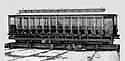 |
A photograph taken in 1921 at the Brill factory in Philadelphia of car number 1 lettered "S. A. FABRICA VOTORANTIM". Brill order 21138 of 4 June 1920 specified three 13-bench motor cars numbered 1, 3 and 5, on Brill 27MCB2 trucks. [col. Historical Society of Pennsylvania] |
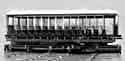 |
A Brill photo of car number 2 lettered "S. A. FABRICA VOTORANTIM". Order 21139 specified two 13-bench trail cars, with arch roofs, numbered 2 and 4, on Brill 76E1 trucks. [col. Historical Society of Pennsylvania] |
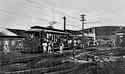 |
Xerox of an undated photograph showing car 1 with two trailers at the original station in Votorantim [see map]. The second trailer with the arch roof appears to be from Brill order 21139. [col. Adolfo Frioli] |
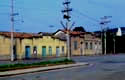 |
The same place as shown in the previous picture, photographed in 1978. The route through Votorantim was relocated about 1940. Note church steeple in both views. [Antonio Gavioli] |
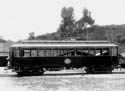 |
An undated photograph of "S.A.F.V." tram 1, after it had been rebuilt as a closed car. It still has the same clerestory roof and Brill 27MCB2 trucks shown in the first picture above. [col. Antonio Gavioli] |
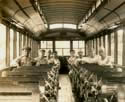 |
Interior view of a Votorantim closed tram, possibly the same vehicle shown in the previous photograph. The absence of sashes in the windows suggests that the picture was taken before reconstruction was complete. [col. Antonio Gavioli] |
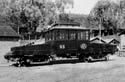 |
No picture has been found, from any period, of passenger tram number 5 specified in Brill order 21138. Could locomotive 5 have been built in its place? Or was it built from passenger tram 5? It has 27MCB2 trucks. [col. Antonio Gavioli] |
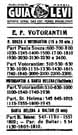 |
A timetable from the Guia Levi of April 1937 indicates three separate services on the Votorantim line. Between dawn and midnight there were hourly runs in both directions from Paula Souza to the town of Votorantim [see map]. Seven of these cars continued to Santa Helena and there were four daily trips from Santa Helena to (Nova) Baltar. [col. AM] |
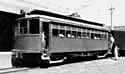 |
Rebuilt tram number 1 at Santa Helena station in 1947 [see map]. [Carlheinz Hahmann, col. Charles S. Small] |
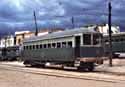 |
Car 3 in 1957 after a second reconstruction. The vehicle is in the same shape as car 1 in the previous photo, but its clerestory has been removed. [William Janssen] |
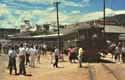 |
Car 3 pulling four 12-window trailers in 1957. The origin of these trailers is unknown. The photograph was taken at Santa Helena near the south end of the line [see map]. Track gauge was one meter. [William Janssen] |
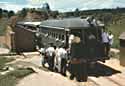 |
The same "train" on the line in January 1957. Not a good place for a photograph . . . [William Janssen] |
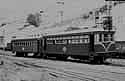 |
About 1960 most vehicles were rebuilt a third time with flat ends, larger vestibules and a shorter passenger compartment with only 11 windows. The bow collectors were replaced with strange round wands. Rebuilt car 3, pulling a trailer numbered 17 (!), was photographed in Votorantim yards in 1963. [Raymond DeGroote] |
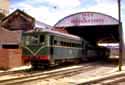 |
This photograph shows rebuilt car 1 in 1963. Compare to earlier views of car 1 above. This was the final form of the Votorantim Brills. [Raymond DeGroote] |
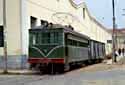 |
Trail cars 2 and 4 were motorized. This picture of car 2 was taken in 1963. [Raymond DeGroote] |
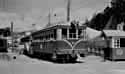 |
Newly motorized car 4 was pulling an unidentified trailer in 1963. As noted earlier, no photograph has been found of a passenger car numbered 5. [Raymond DeGroote] |
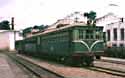 |
Car 2 in this view, taken in 1963, is followed by an unidentified 11-window motor car and a 12-window trailer. Votorantim yards. [Earl Clark] |
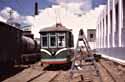 |
After the closure of the Sorocaba tramway in 1959, the Votorantim railway purchased Sorocaba two-axle car 3, which it converted to a line car, repainted and numbered CS5. Here it is in 1963. [Raymond DeGroote] |
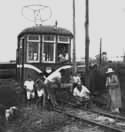 |
Votorantim line car CS5 – former Sorocaba passenger car 3 – repairing the track in October 1965. [col. AM] |
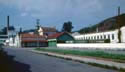 |
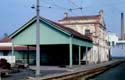
The company's main station, shops and yards in Votorantim. The line originally ran on the street in the foreground (see third and fourth illustrations above). This photograph was taken in 1978. [Antonio Gavioli] |
 |
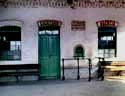
The passenger station in Votorantim, 1978. The track on the right is the new route established about 1940. [Antonio Gavioli] |
 |
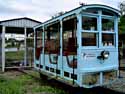
The ticket window and company offices at Votorantim station. 1978. [Antonio Gavioli] |
 |
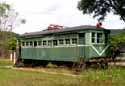
A new inspection car appeared recently on the line – even though there is not much left to inspect. A sign of things to come? [Rafael Santino] |
 |
EFEV passenger car 3 was preserved and is displayed today near the cement works in Santa Helena. This photograph was taken in March 2005. [Martin Murray] |
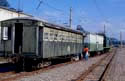 |
One of EFEV's three General Electric locomotives pulling a freight car and passenger trailer in 1978. The passenger car, numbered 17, would be converted into a luncheonette. [Antonio Gavioli] |
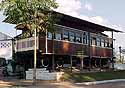 |
After 20 years as a luncheonette (see previous photo), passenger trailer 17 was restored to somewhat original condition and is displayed today on a ranch near Sorocaba. [Nicholas Burman] |
Return to Introduction
See pictures of Sorocaba urban trams
Go to map